Factory setup & training
Plan your nonwoven
bag factory.
Build the production plan around your bags, materials and customers. HAOLON helps connect machine selection, printing, factory layout, commissioning and operator training.
Discuss your requirements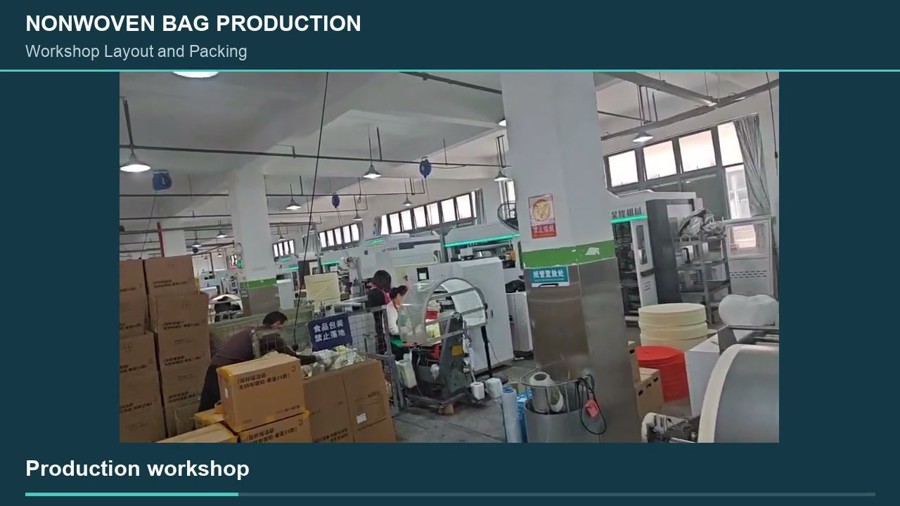
01 · Define the project
Start with the bags you plan to sell.
A useful factory plan starts with a small, clear product range. Record each bag’s face width, height, gusset, handle style, material structure and printing requirements. A photo shows the appearance; dimensions and a material sample help determine the production route.
List your initial order sizes, expected bag mix and available shifts. This makes it easier to compare machines, allow for changeovers and identify which production stages to bring in-house.
- Product: box bags, vest bags or other supported configurations, with a dimensioned drawing for each priority size.
- Material: fabric type, coating or lamination, weight in g/m², roll or sheet format, and supplier samples.
- Demand: target bags per shift, batch sizes, number of designs and expected order changes.
- Site: country, building plan, available power supply and your intended start date.
02 · Choose the process
Match the feed format to the product.
| Production route | Equipment to explore | Planning consideration |
|---|---|---|
| Roll-fed box bags | HL-58 or HL-58V | Plan around suitable roll material, bag dimensions, handle processing and three-dimensional forming. |
| Sheet-fed box bags | HL-68 | Uses pre-cut extrusion-coated nonwoven sheets in the specified 80–120 g/m² material range. Include sheet preparation and storage in the process. |
| Vest bags and related formats | A700 | Specify the bag style, edge-processing version, punching dies and accessories. The published nonwoven weight range is 30–120 g/m². |
Material ranges and dimension limits are a starting point. The complete bag design and input material need to suit the selected configuration; individual maximum dimensions do not establish that every combination is possible.
03 · Prepare the material
Decide where printing fits.
Printing and bag making are separate production stages. You can purchase suitable pre-printed material, arrange printing externally or include a printing line in the factory plan.
For in-house printing, compare artwork, colour count, material surface, print repeat and drying requirements before choosing flexographic or screen printing. Match the printed roll layout to the downstream bag-making process. A sheet-fed route also needs correctly prepared pre-cut sheets.
Read the printing equipment guide04 · Prepare the site
Plan the working space around the machine.
A published machine footprint is only part of a factory layout. Allow access for roll or sheet loading, operators, maintenance, finished-bag collection and material handling. Keep raw material, work in progress and packed goods in defined areas.
As a reference, the HL-58 installation dimensions are 8.5 × 5.87 × 2.5 m. The final layout needs additional working clearances and must account for the actual building, equipment configuration and access route.
- Check entrance sizes, unloading arrangements, internal transport and the machine position.
- Confirm voltage, frequency, connected load and other utility needs for each quoted machine.
- Plan the flow from material receipt through printing, preparation, bag making, inspection and packing.
- Provide access for maintenance and space for tooling, consumables and spare parts.
05 · Commission & train
Prepare the team as well as the site.
Agree the installation and commissioning scope before ordering. Identify who prepares the site, supplies trial material, receives the equipment and takes responsibility for utilities. Set out the bag designs and checks to use during commissioning.
Operator training can cover material loading, parameter setup, bag-size changes, start-up checks, routine quality inspection, cleaning and maintenance. Include the people who will operate the line and the technicians who will support it.
Your next step
A practical brief for your first discussion.
Send your priority bag samples or drawings, material details, target output, factory dimensions, country and power supply. If you are still deciding what to produce, explain your intended customers and share a few representative bag designs.
These details give us a basis for discussing the machine configuration, printing route, layout and service requirements together.
Turn your bag designs into a factory plan.
Share bag drawings, material samples, your target output, country and factory layout so we can discuss a suitable equipment and service scope.